
A Deliverable That's Really an Engine: Classifying a Business You Can Verify
We judge a build by two questions: can you verify it, and can you point it at the next problem? A recent one clears both bars — and the discipline behind it is the discipline behind everything we run.

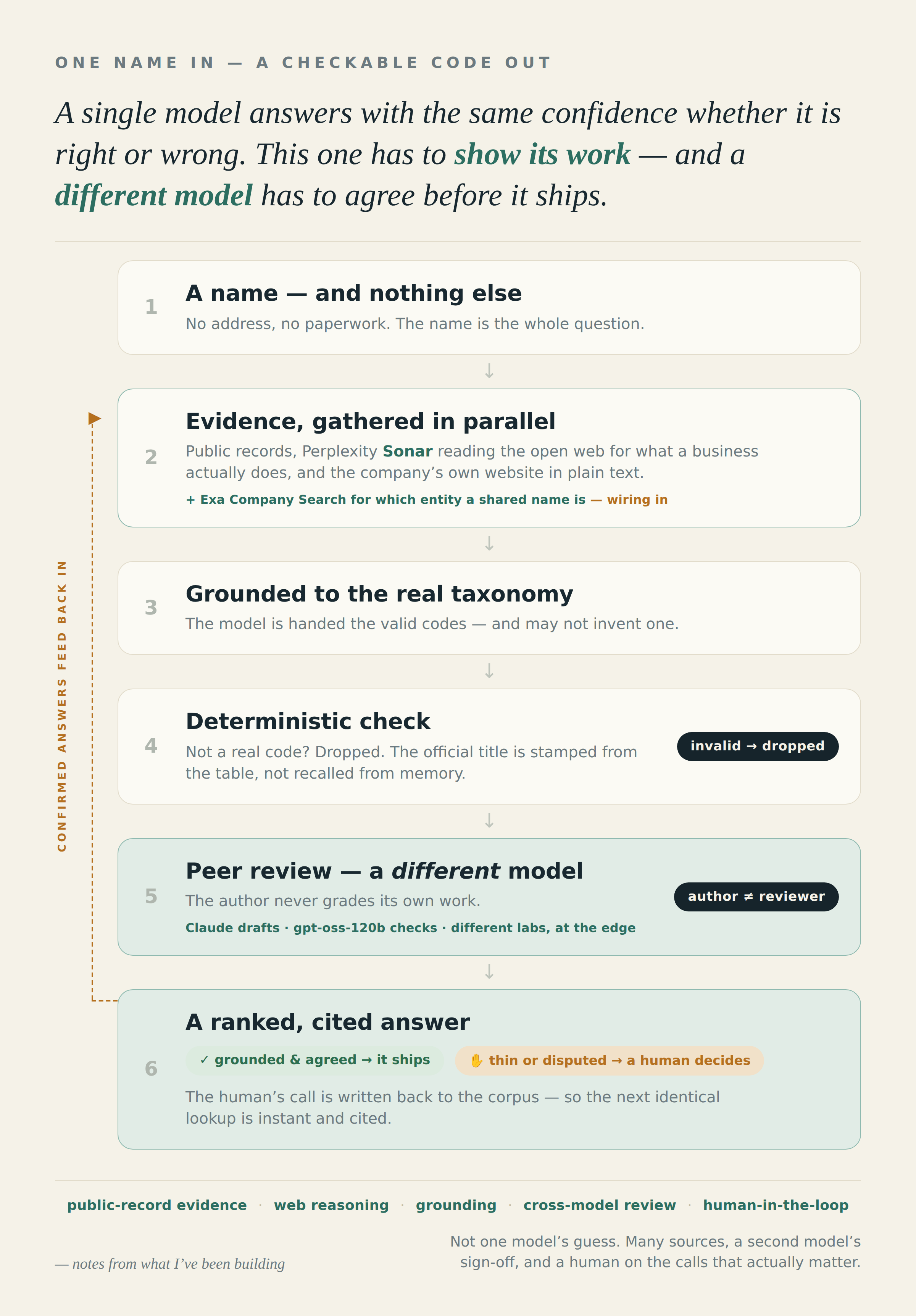
We judge a build by two questions. Can you verify it? And can you point it at the next problem? A recent one clears both bars, and it is worth walking through, because the discipline behind it is the discipline behind everything we run.
The build is small on its face: a person types a business's name — just the name, no address, no paperwork — and gets back the correct industry classification code, ranked, with the reasoning attached. The interesting part is what sits underneath, and why we insisted on it.
Confidence is not accuracy
A single AI model answers with the same confidence whether it is right or wrong. That is the failure mode we design against on every build, because a confident wrong answer is worse than no answer — it gets trusted. So the tool is built to corroborate rather than assert: it gathers evidence before it reasons, grounds every answer in a real source, and is never allowed to bluff.
What sits under it
The tool fans out across public data sources in parallel — filings, federal records, licensed-provider registries, geographic and facility data — and adds a live web layer (Perplexity's Sonar) to read what a business actually does, plus a direct read of the company's own website. Candidate codes are constrained to the real taxonomy, so the model cannot invent one. Then two verifiers run: a deterministic check that drops any code that is not real, and a cross-model check in which the author never grades its own work — one model drafts the answer, an independent model from a different lab checks it, and anything disputed goes to a person. Every human-confirmed answer is written back, so the system gets sharper with use. (An entity-resolution layer, Exa, is being wired in to separate businesses that share a name.)
A deliverable that is really an engine
This began as a single, tightly scoped build. It did not stay one. Strip the industry codes out and what remains is a reusable engine: gather evidence, ground it, have an independent model check the first one's work, and keep a human on the calls that carry weight. That engine does not care whether the input is a business name or something else. It is the same argument we make across the portfolio — build the reusable, verifiable thing once, then point it at the next problem rather than starting over.
Not just our opinion
This is not a house style; it is where the guidance points. MIT researchers published a method this year for catching overconfident models, and their reliable signal is disagreement across different models — the cross-model check. MIT's own guidance says to evaluate output with human judgment, verify against authoritative sources, and ground before generating. NIST's AI Risk Management Framework calls a system "valid and reliable" only when that is demonstrated, with a human able to step in where it cannot catch its own errors. We hold our builds to that standard because our customers inherit the consequences if we do not.
The full technical breakdown of this build lives on jessemyers.ai.